In my last post I explained what I mean by object-based AI: your business’s own systems become the reusable parts the AI runs on, so everyone in the company works towards the same objective and gets the same standard every time. That post was the idea. This one is the practical side.
If you run a company, direct one, or manage a team, here is how you connect business systems to AI, and the four pieces you need in place to do it. I go through all of it in the video below, so you can watch that first or read on.
Start with “this is how we do things here”
Every business already has systems, whether or not anybody has written them down. This is how we do things here: A, B, C, D, E, and we arrive at the same objective every single time. How we take on a new client. How we quote a job. How we close off the month. If you have managed anything at all, you have come across them.
That is what I mean by a business system, and it is the thing AI understands best. Your business systems are the language of AI.
Most companies I talk to are using AI without them. Everyone has their own prompts and their own way of asking, and everyone gets their own answer. They are busy. They are getting more done. But their energy is all going in slightly different directions, and nobody is being advised on how this particular company does things. Connecting the AI to your systems is what points everyone the same way.
There are four pieces. I will take them in the order I would put them in.
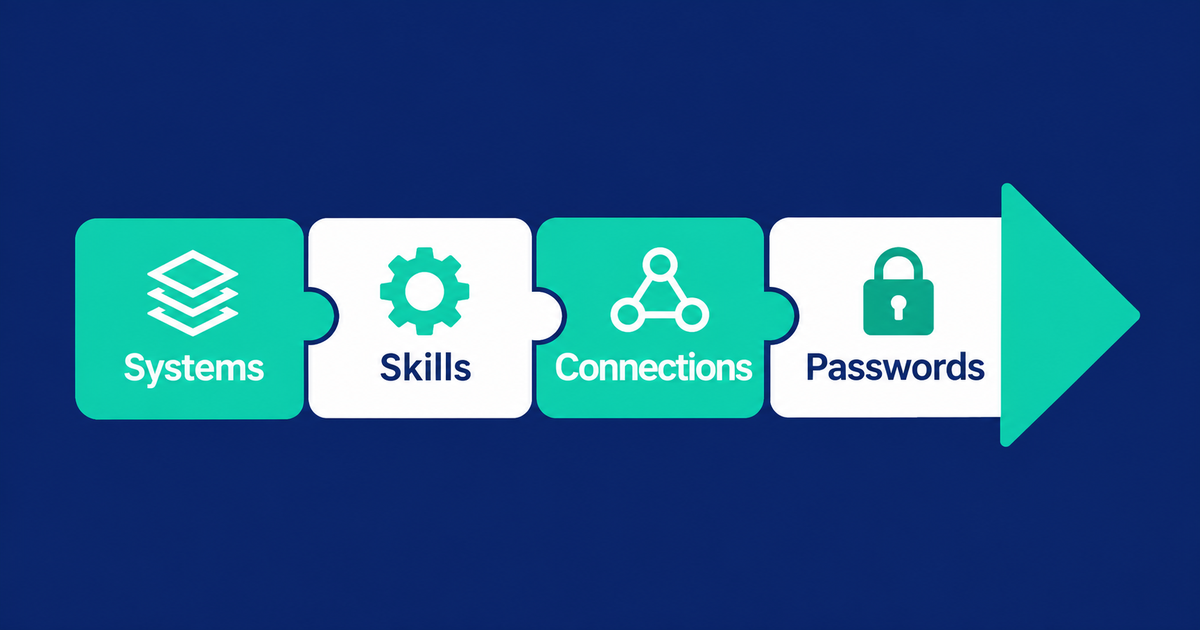
One: your business systems, written down
Nothing else works until this is done. A system that lives in a senior person’s head cannot be given to an AI. It has to be written down, step by step, in the way your business actually does it.
I use systemHUB to hold ours, and I would suggest it for yours. It is built for exactly this: one place where every system in the business lives, in a form a person or an AI can follow.
If a system does not exist yet, that is not a reason to stop. Claude can help draft it. Sit the person who knows the job best down with Claude, talk it through, let Claude turn the conversation into clear steps, and then correct it together. In my experience that is far quicker than staring at a blank page, and it gets the knowledge out of someone’s head and into the business. I have written more about how we build business systems if you want the detail.
Two: skills inside the AI
Once a system is written down, it goes into the AI as a skill. In Claude these are called Claude Skills: a set of written instructions for one kind of work, which Claude follows every time that work comes up. Your year-end system becomes a skill. Your client onboarding system becomes a skill. From then on, anyone in the company who asks Claude to help with that job is guided the way your company does it.
I am sure the other AI tools have, or will have, something similar. Whatever you are using, look for the place where you can give it your systems to follow. That is the piece that turns a general-purpose AI into one that knows how you work.
This is also why I keep saying prompts do not matter. A perfect prompt cannot replace a business system that tells the AI how your company does things. Context and systems are what matter.
Three: connections to the software you already use
A system that only lives in a chat window can only advise. The real work happens in your software: your CRM, your accounts package, your ERP, your marketing and project management tools, and whatever else matters to your business.
So the third piece is connecting the AI into those. When Claude is connected to your CRM, a step like “check where this client is” is not a reminder, it is something Claude can actually do, in the place your team already keeps the information. Connect it to the accounts package and it can work with the real file. Connect it to your project management tool and it can see what is done and what is not.
You do not have to connect everything on day one. Start with the software the system you have just written down actually runs in.
Four: a password manager
The last piece is the one people forget. Once an AI is connecting into your software, logins have to be handled properly. Use a password manager such as 1Password, or whichever one you already use, so logins are used securely rather than passed around in messages or stuck in a document. Access can be given to the people and the jobs that need it, and taken away again when they do not.
What you get when the four are in place
Everyone in the company is using AI, for sure. But their energies are not going in different directions any more. They are all going the same way, because they are using your business systems within the AI. The junior and the senior follow the same steps towards the same result. It is the conveyor belt again: each person is moved along towards the objective, and the AI keeps them on it.
That is also how AI stays on track and inside your guardrails. And your systems stay your own. Set up the right way, on a business plan with training switched off, they stay within your company and are not used for training.
Where to start
Pick one system. The one that is done most often, or the one where the standard slips when the wrong person does it. Write it down, put it into the AI as a skill, connect the AI to the software that job runs in, and sort the logins. Then do the next one.
If you would rather not do that yourself, find someone who can take your business systems, understand them, and connect them into the AI. That is the work we do at Irish Web Solutions, and it is where I think every business is heading, whether the AI is Claude, ChatGPT, Copilot or whatever comes next.
Because here is the thing. If you are using AI without your business systems, you are using AI wrong.
Book a session now!
Not sure which of your systems to connect to AI first? That is exactly what our free AI Health Check is for. We will look at how work moves through your business, spot the system where AI will make the biggest difference, and show you what it is worth. Book your free AI Health Check.
And if you would rather hear it from me, watch Prompts Don’t Matter Anymore: The Future Is Object-Based AI on the Irish Web Solutions channel.